
Best P&L Reporting Tools in 2026: AutoBizz vs. TripleWhale, BeProfit, and More
January 1, 2026 - Sadia Tahreem
Running ads as a Shopify store owner is easy. Knowing if those ads are truly profitable? That's the hard part. Between ad spend, cost of goods, shipping, and platform fees, getting a clear picture of daily profit can feel impossible. That’s where P&L (Profit & Loss) reporting systems step in.
Today, we’re comparing the leading options AutoBizz, TripleWhale, BeProfit, and Lifetimely to see which tool actually helps founders cut through the noise.
Why Profit & Loss Reporting Matters for Shopify Stores and other businesses?
Most Shopify Store owners and CEOs worldwide eventually face the same questions:
- Which ad platform is eating into my margins?
- Are my Google Ads more profitable than Meta Ads?
- After COGS, shipping, and fees, am I even making money?
Unfortunately, Shopify, Google Ads, and Meta don’t talk to each other. The result: spreadsheets, guesswork, and late-night calculations. Dedicated P&L tools promise to fix that.
AutoBizz: Daily P&L Without the Bloat
AutoBizz was built specifically for Shopify store founders who want clear profitability reporting without enterprise complexity.
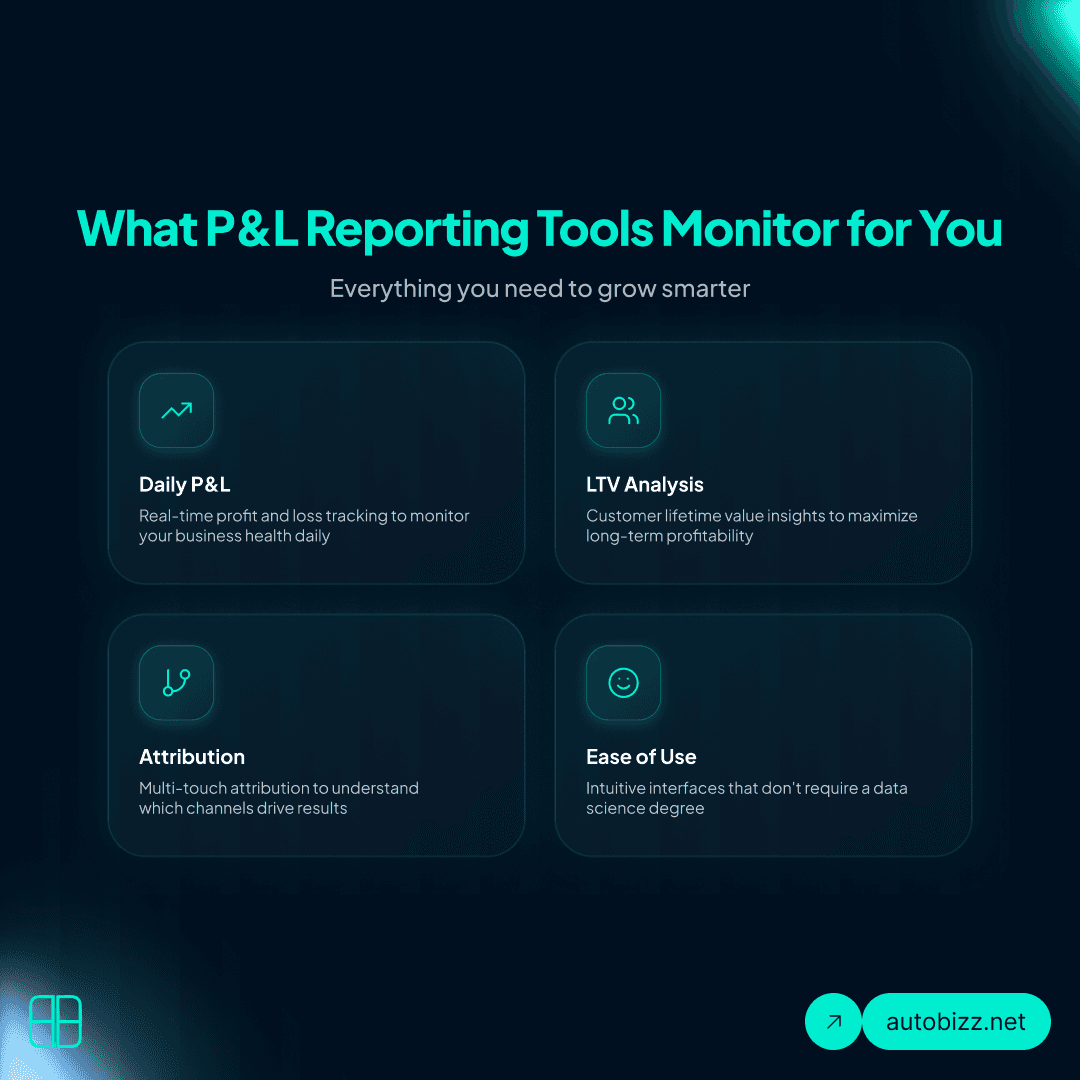
- Daily P&L breakdown: Revenue, ad spend, COGS, fees, all in one dashboard
- Cross-platform visibility: Google, Meta, TikTok, Snapchat, and Shopify
- Transparent pricing: Flat fees, no revenue tax
- Easy onboarding: Connect in minutes, no steep learning curve
- Future-ready insights: Natural-language queries like “Which campaign gave me the highest ROAS last week?”
Best for:
Shopify stores from $10k to $100M revenue looking for clean, no-bloat reporting.
Pricing:
Starting from $100/month, up to 5x cheaper than enterprise tools.
Triple Whale: Feature-Rich but Pricey
One of the best-known analytics platforms for Shopify, combining multiple tools into a single dashboard. Great for larger, data-heavy teams.
Key Features:
Multi-channel ad/revenue tracking, attribution models, creative performance, AI-powered “Moby Agents.”
Best for:
Mid-to-large brands with marketing/data teams.
Pricing:
From $149/month, scaling to $219+.
Downside:
Expensive and can feel bloated if you just need simple P&L.
BeProfit: Accessible and Visual
A profit-tracking app with intuitive dashboards and detailed expense tracking for everyday clarity.
Key Features:
Real-time profit dashboards, shipping/discount/fee tracking, product-level analytics, UTM attribution, LTV cohorts (higher tiers).
Best for:
Small-to-mid stores that want easy insights with room to scale.
Pricing:
From $49/month, up to $249/month for multi-store and custom reporting.
Downside:
Advanced features are locked behind higher plans.
TrueROAS: Transparent and Performance-Focused
Attribution and profitability tracking with all features included pricing is based only on sales volume.
Key Features:
Conversion API, custom attribution, report builder, fast data refresh, full customer journey mapping.
Best for:
Scaling brands and agencies needing reliable, predictable tracking.
Pricing:
$82/month (starter) → $746+ (enterprise).
Downside:
Cost rises with sales volume, which may be less efficient for very high-revenue stores.
Lifetimely: LTV Meets P&L
Analytics focused on both daily profitability and long-term customer value.
Key Features:
Real-time P&L, QuickBooks integration, CAC vs. LTV insights, cohort and retention tracking, predictive LTV, custom reports.
Best for:
Brands scaling with retention and long-term profitability in mind.
Pricing:
Free (50 orders/month), paid plans from $149/month.
Downside:
Price climbs quickly, and advanced reports may be overkill if you only want basic P&L.
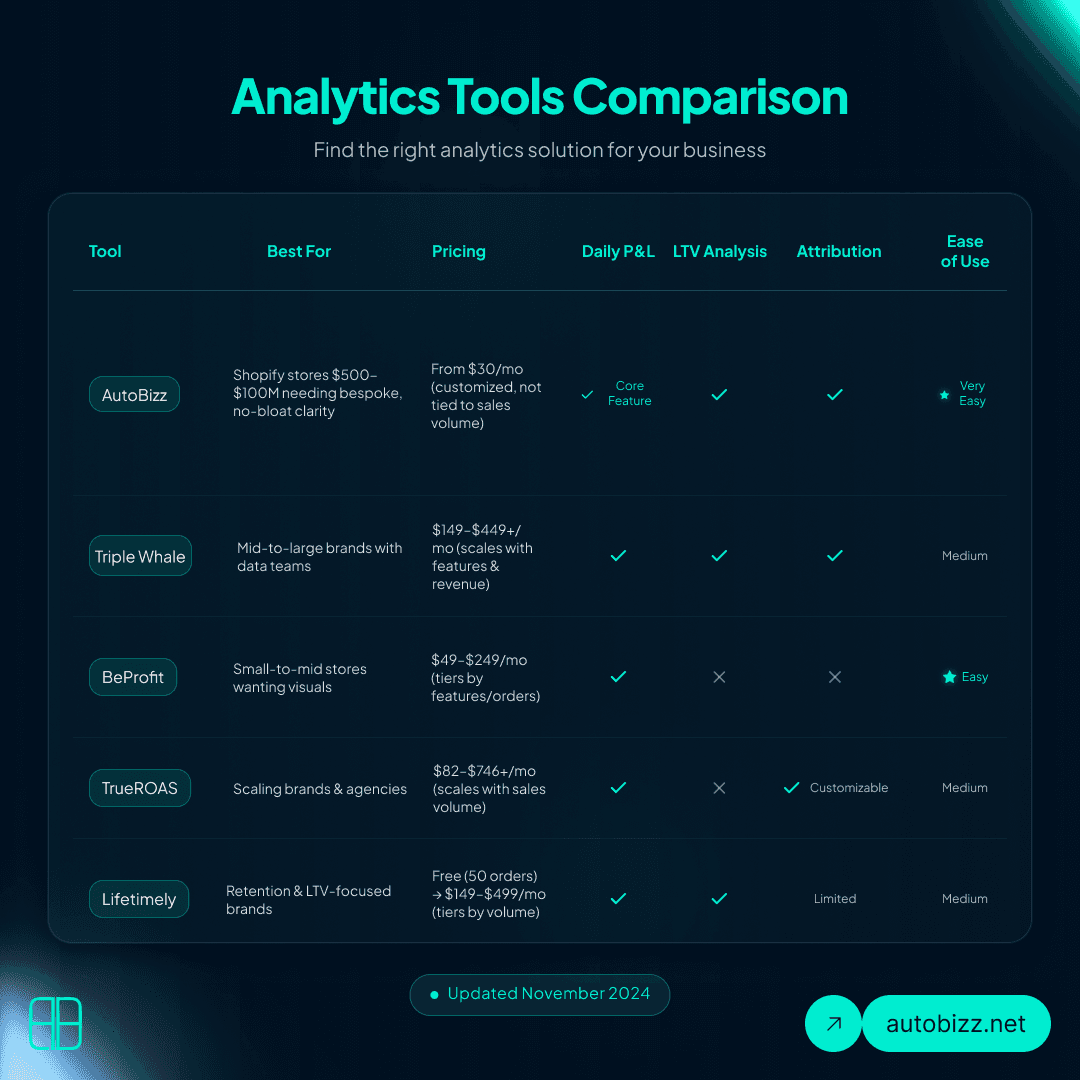
Head-to-Head Comparison
Final Thoughts
If you’re a large brand with a data team, TripleWhale or Lifetimely may suit your needs. If you’re just starting out, BeProfit is an affordable entry point.
But for the majority of Shopify founders who want daily clarity without overpaying, AutoBizz is the leaner, smarter choice.
- Clear daily profit reporting
- No enterprise bloat
- Transparent pricing